Watch Lahav at 4:15 and 5:40
Author: lahavharkov
Where will the ‘tough questions’ about Protective Edge be asked?
Like many IDF operations before it, Operation Protective Edge will be examined and inspected, probed and scrutinized from all angles within Israel and around the world.
The UN Human Rights Council investigation led by Canadian Prof. William Schabas – who was derided by many this week after he refused to admit Hamas is a terrorist organization, and said Prime Minister Binyamin Netanyahu should be prosecuted for Operation Cast Lead even though he was opposition leader at the time – is being snubbed by the government, with the Foreign Ministry calling it a “kangaroo court.”
Following on from the UNHRC announcement, State Comptroller Joseph Shapira announced he would open his own investigation.
Ten days earlier, while IDF soldiers were still on the ground in Gaza, Knesset Foreign Affairs and Defense Committee chairman Ze’ev Elkin (Likud) announced his panel would ask “tough questions” about the operation and, true to his word, set the groundwork for an investigative committee this week.
Elkin’s announcement that his committee would probe Operation Protective Edge brought up a flurry of questions and responses from the coalition and opposition: Do MKs have access to all the classified information needed for such an examination? Wouldn’t an official commission of inquiry, with greater executive power, be a better choice? Can politicians really investigate other politicians without bias?
As with so many other things in the Knesset, the answers depend on politics. Continue reading
‘Even one rocket is too many’
Residents of rocket-beaten South congregate in Tel Aviv to demonstrate, demanding to be able to live in peace and quiet.
Tens of thousands of demonstrators from all over the country, including whole families from the South, kids and pets in tow, filled Tel Aviv’s Rabin Square Thursday night to show solidarity with the towns near the Gaza border that have been constantly hit by rockets and mortar shells.
Protesters carried signs with slogans like “We won’t be quiet,” “Gaza border residents are Israeli citizens, too!” “Even one rocket is too many,” “We trust the IDF” and “Conquer Gaza now!” They chanted “The nation demands justice” and “We love the IDF.”
One sign in English quoted the film The Good, The Bad and The Ugly in an apparent reference to the recent spate of on-and-off cease-fires: “If you want to shoot, shoot. Don’t talk.”
Meanwhile, rock bands that hail from Sderot – such as Teapacks and Knesiyat Hasechel – played for the crowd, as did pop singer Keren Peles.
It was the night of the Kassam generation.
Thousands of teenagers from the South, wearing red shirts representing the Color Red rocket-warning sirens they have heard their entire lives, were a major presence in Rabin Square. Several gave speeches during the rally.
“Is it normal for a teenage girl to get up in front of thousands of people and talk about living under the threat of missiles?” Tom Katz, 16, a third-generation resident of Nahal Oz, asked on stage. “Did you know that an antitank missile was shot at our school bus?” Continue reading
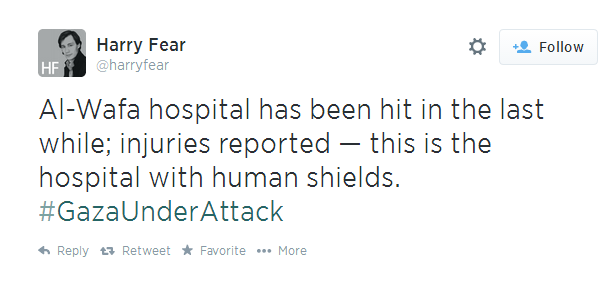
Journalists report on use of human shields in Gaza – A series
Gaza reporters’ tweets: Hamas using human shields
Several journalists from around the world reported seeing rockets fired from civilian areas in Gaza in recent days, and received threatening tweets in return accusing them of “informing” the IDF. Continue reading
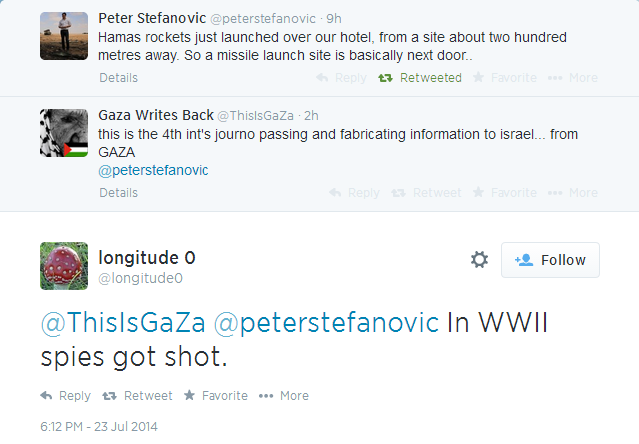
Journalists threatened by Hamas for reporting use of human shields
The international press in Gaza has hardly reported on how Hamas has operated in this round of fighting, and photos or video of Hamas fighters from recent weeks are rare.
The reason became apparent this week as several journalists reported being threatened and even expelled from Gaza for highlighting that the terrorist organization used civilian sites to attack Israel. Continue reading
Foreign press gives mixed accounts of Hamas intimidation in Gaza
Some journalists from international news outlets denied being threatened or intimidated by Hamas while reporting from Gaza, though other accounts from recent days paint a different picture.
Indian television station NDTV broadcast a report by Sreenivasan Jain on Tuesday showing rockets being assembled and shot from a tent next to his hotel, in what seems to be the only video of the sort coming out of Gaza during Operation Protective Edge. Continue reading
Reporter: Gazans only want us to show damage, not shooting
In recent weeks, there has been much discussion about whether or not reporting by foreign press in Gaza can be trusted, due to accounts – some confirmed, some denied – of Hamas threatening and intimidating reporting.
The Jerusalem Post attempted on Thursday to contact ten journalists who reported from Gaza in recent weeks. Of the few who responded most declined to be interviewed, even on condition of anonymity, as they plan to return to Gaza to report.
Christian Stephen, founder of “Freelance Society,” a media company specializing in hostile environments and conflict zones, which sub-contracts for The Economist, VICE, Vocativ and other press outlets, agreed to discuss his experience reporting from Gaza, because he is in Israel and heading to Iraq in nine days.
“Hamas can’t get me there,” he quipped. Continue reading
Foreign Press Association blasts Hamas for threatening journalists
Hamas is using threats and pressure to prevent journalists from providing objective reports, the Foreign Press Association in Israel said in a statement Monday.
The organization said it “protests in the strongest the blatant, incessant, forceful and unorthodox methods employed by the Hamas authorities and their representatives against visiting international journalists in Gaza over the past month.” Continue reading
Operation Protective Edge on Canada’s Sun News
Public diplomacy ‘a war front like any other’
Experts say efforts to spread Israel’s message around the world have markedly improved since previous skirmishes in Gaza.
The Prime Minister’s Office and Foreign Ministry have been hard at work spreading Israel’s message in Operation Protective Edge for the last week in an effort that is mostly paying off, experts on public diplomacy in and out of the government said Sunday.
“We see [public diplomacy] as a war front like any other,” Foreign Ministry Deputy Director-General for Communications and Public Diplomacy Arthur Koll explained. “It’s a different kind of warfare, not one where missiles are flying or gunshots, but there is great importance to words, feelings and the sympathies people develop. It’s important to our national security. In this operation, it’s a central arena.” Continue Reading
Reporter’s Notebook: We have love, and it will win
https://www.instagram.com/p/p4Z_GRMq-y
During the 18 days between when Eyal Yifrah, Naftali Fraenkel and Gil-Ad Shaer went missing and when their bodies were found, I prayed for them more times than I can count, my eyes inevitably welling up with tears each time.
I prayed in the Knesset with lawmakers across the political spectrum, becoming a part of the story I was reporting. I prayed in synagogue. I prayed at home, reciting Psalms in my heart. But mostly, I prayed with the Israeli people and the Jewish people who were united in hope that the boys would come home safely.
I also went to Tel Aviv’s Rabin Square to pray three times. First, two days after the news came out, with hundreds of people cramped into the square’s southern end, as most of the area was filled with the annual book fair. Second, on Sunday night at a prayer rally, with thousands of people, who were bussed in from all over Israel, filling the square.
Then, I returned late Monday night. This time, I was praying in the boys’ memory. Continue reading
https://www.instagram.com/p/p4aa4BMq_l https://www.instagram.com/p/p4c7vAsq0C
Ruby’s Tuesday: From safe bet to unexpected winner
Haredi parties, united at the last minute, became king-makers again as they didn’t vote for Sheetrit because he “co-sponsored many anti-religious laws,” says Shas MK.
In retrospect, Reuven Rivlin’s victory in the presidential election seems inevitable.
He was the front-runner all along, with the most open support from MKs and 73 percent of the public, according to polls.
Yet no political commentator worth reading or listening to was willing to gamble his or her reputation on a prediction that Rivlin would win, even though he had been campaigning for the presidency from the moment he lost the previous election seven years ago. Continue reading
Presidential Visions
The leading candidates in the election presented to ‘The Jerusalem Post’ their vision of what the President’s Office will be like under their leadership.
On Tuesday, 120 MKs will elect Israel’s 10th president out of six candidates: MK Reuven Rivlin (Likud), MK Binyamin Ben-Eliezer (Labor), MK Meir Sheetrit (Hatnua), Dalia Itzik, Dan Shechtman and Dalia Dorner.
Anything could happen, since the vote is by private ballot and many lawmakers are keeping mum about their plans.
There will most likely be two rounds to the election, because the unusually high number of candidates will make it difficult for anyone to get a majority. The second round will pit the two candidates with the most votes against each other.
Rivlin is expected to reach the second round easily and Ben-Eliezer and Itzik are seen as front-runners to face him. At that point, the result will remain to be seen.
The leading candidates this week presented to The Jerusalem Post their vision of what the President’s Office will be like under their leadership. Continue reading
Sen. Ted Cruz blames Palestinians for failed peace talks
America has no business dictating terms on issues of vital national security to Israel, US Sen. Ted Cruz (R-Texas), a possible candidate for the Republican presidential nomination in 2016, said in the Knesset Monday.
He placed the blame on the Palestinians for the recent failure of peace talks, saying “the principal impediment to peace is that, to date, the Palestinians have refused to recognize Israel’s right to exist as a Jewish state and have refused to renounce terror.
“Unless and until the Palestinians can agree on those very basic starting blocks, no lasting peace solution is likely,” he stated. Continue Reading
 Lahav Harkov