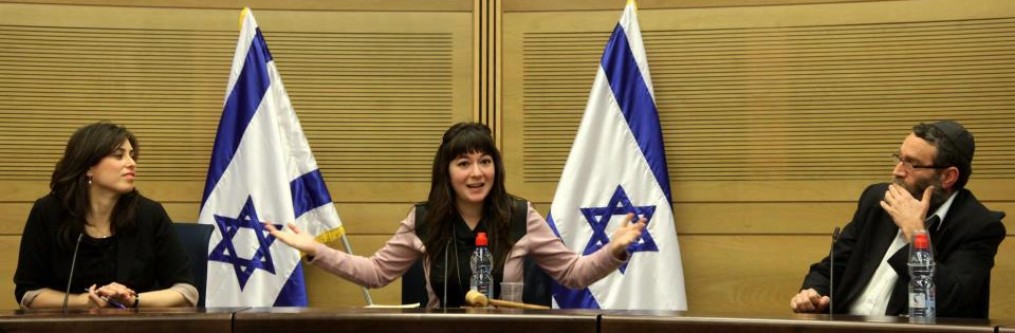
The Knesset at 69: Still struggling for the public’s trust

While members of Knesset represent Israel’s diverse society, they’re still seen as self-interested and ineffectual by the public.

Most of the public – 68% – do not think members of Knesset work hard and do their job, a poll by the Israel Democracy Institute found ahead of the Knesset’s 69th birthday on Tuesday.

The poll, conducted by the IDI’s Guttman Center for Public Opinion and Policy Research, also found that 80% of Israelis think politicians care more about their own interests than those of the public, with 65% saying politicians are disconnected from the public’s problems and needs, and 64% saying the government does not deal well with the public’s primary issues. In addition, 78% of Israelis think they cannot influence government policy.

Continue reading

How I became Public Enemy No. 1 in Poland

All because of one tweet.

I am, apparently, an enemy of the Polish people.

I am a prime example of that treacherous lying Jewish media with its tentacles wrapped around the earth, or something not-at-all-antisemitic like that. I am the reason Jews are killed and thrown out of every country they try to live in around the world. I am to blame for the Holocaust, and it’s too bad I was born. I am also a c*** and a bitch who’s asking to be raped, and who deserves to be sent photos of strangers’ genitals. And I’m stupid. Oh so stupid. A real idiot who’s never read a book.
Or so thousands of Polish people told me on social media since Saturday night.

Even Poland’s Deputy Minister of Justice Patryk Jaki piled on, labeling me “Israeli media” – at least that one is true – and telling his followers to come after me.

All because of one tweet. One tweet in which I wrote the phrase “Polish death camps” 14 times. Continue reading

A relaxing weekend in Eilat – with some Likud MKs thrown in

The weekend wasn’t as wild or as weird as past write-ups would have one expect.

In some ways, the Likudiada, an annual retreat in Eilat for Likud members, is not that different from any other weekend at a resort full of Israelis. There’s a stand-up comic and a Mizrachi singer performing at the hotel. There’s the rush to get in some VAT-free shopping. People could be heard singing the Shabbat song Habibi, ya habibi, ha’el hamelech after meals, to which some wore suits and ties, while others sported sweat suits.

There was a giant buffet breakfast, adults relaxing by the pool while kids splashed around, with questionable background music playing, even on Shabbat. Some played backgammon in the lobby and ate sunflower seeds and dried apricots, while others read newspapers.

But, at a regular weekend in Eilat, Communications Minister Ayoub Kara doesn’t partake in the sunflower seeds, MK Yehudah Glick doesn’t get up to give a Dvar Torah (Torah thought), and you don’t bump into Social Equality Minister Gila Gamliel hanging out with her kids. Continue reading

In Netanyahu’s coalition, parties jockey for headline-grabbing legislation

Judging from the news coming out of the Knesset the last few weeks, Jerusalem was saved from imminent danger of being split in a deal with the Palestinians, Prime Minister Benjamin Netanyahu just barely avoided the police recommending his indictment, all the stores in the country are about to be shut down on Shabbat, and executioner is going to be a new, in-demand job when all the terrorists get the death penalty.

But that’s fake news.

All of these attention-getting bills spurred a lot of talk, but won’t bring about much change in practicality.

And on the way, they weaken the Knesset’s effectiveness by using it as a platform for virtue signaling.

Continue reading

What everyone is getting wrong about the new Jerusalem Law

After the Knesset passed the “Jerusalem Law,” Palestinians are raging (again) and The New York Times says the two-state solution is doomed (again).

MKs from Bayit Yehudi, which proposed the bill, are applauding it as safeguarding the city from ever being divided in order to be shared with the Palestinians.

But it seems like many are missing what the bill’s most likely use will be: to split neighborhoods beyond the separation barrier from Jerusalem’s municipal borders, in accordance with Jerusalem Affairs Minister Ze’ev Elkin’s plan.

Continue reading

Knesset dawdles while Trump moves to cut PA funds going to terrorists

While US President Donald Trump threatened funding to the Palestinian Authority in a tweet and in action at the UN this week, the Knesset bill to slash tax transfers to the Palestinian Authority as long as it continues to pay terrorists, remained stuck on Wednesday, 10 months after it was proposed.

It is “uncomfortable” that the American version of the bill is making progress, but in Israel, it’s stuck, Yesh Atid MK Elazar Stern told The Jerusalem Post.

Stern introduced the bill in March, based on the Taylor Force Act, a bill by Senator Lindsey Graham (R-South Carolina) that would stop all US aid to the Palestinians as long as they pay salaries to terrorists and their families.

The bill, named after an American victim of Palestinian terrorism, passed in the House of Representatives in December and is awaiting Senate approval.

Stern’s version would deduct the amount of money the PA gives to terrorists in Israeli prisons or to the families of those killed by Israel, from the tax and tariff money Israel collects for the PA.

The terrorists’ salaries are anchored in PA law, and the amount increases with every Israeli they kill, amounting to an estimated NIS 1.2 billion annually.

“Every day in which this law has not passed, Palestinian youth live in an atmosphere that motivates terrorism and makes terrorism look worthwhile to them,” Stern lamented.

Continue reading

Year in review: The highs and lows of Israeli politics in 2017

On January 2, 2017, Prime Minister Benjamin Netanyahu started off his year with a police interrogation, setting the tone for a political year dominated by the fallout from investigations into allegations that he received illegal gifts from businessmen and attempted to negotiate sympathetic coverage in Yediot Aharonot in exchange for weakening its competitor Israel Hayom.

Days later, the “French bill” was on the agenda, which was based on a French constitutional provision that exempts the president from criminal investigations – except in the Israeli version, it would apply to the prime minister.

The highly controversial bill was replaced by a different proposal later in the year, the “police recommendations bill,” which would bar police from recommending to the attorney-general whether to indict or not at the close of an investigation. That bill went through many changes in recent months, including narrowing its scope to not even include Netanyahu’s investigation, but is still the opposition’s top target ahead of a Knesset vote that’s been postponed many times.

The weekly demonstrations against corruption, which often looked more like rallies against Netanyahu or Attorney-General Avichai Mandelblit, grew larger and larger until they no longer fit in Mandelblit’s Petah Tikva neighborhood and in the last few weeks of the year moved to Tel Aviv’s Rothschild Boulevard.

At the end of January, Police Chief Insp.-Gen. Roni Alsheikh said the investigations into the prime minister’s conduct would end in the coming weeks, but Netanyahu ended his year much as he began it, and was questioned again over Hanukka.

Continue reading

Everything you wanted to know about the Police Recommendations Law, but were too afraid to ask

mid the chaos of the last three days’ filibuster in the Knesset – Chanting Lamentations in the Yemenite tune! Shakespeare recitations! Near-fisticuffs between Joint List MK Haneen Zoabi and Likud lawmaker Oren Hazan! – something got lost. That something is the actual legislation that passed overnight Wednesday, the Police Recommendations Law.

If you’re confused about this law and why it became such a big deal, we (one hopes) have all the answers.

Continue reading

New York Post: The global media’s deranged ‘Jerusalem syndrome’

For most Jewish Israelis, Jerusalem has been the capital for 3,000 years, and will continue to be. We appreciate Trump’s declaration, but we didn’t need him to know the truth, and we don’t need to be scared or panicked over him saying it, either.

Jerusalem Syndrome is a phenomenon in which people become psychotic, usually on a religious or messianic theme, upon visiting the holy city.

There seemed to be another kind of Jerusalem Syndrome going around since President Trump decided to, in his own words, “finally acknowledge the obvious: that Jerusalem is Israel’s capital.”

The psychosis began with much of the media and the usual European suspects tut-tutting and breathlessly anticipating violence as if the Palestinians are Pavlovian lab subjects of condescending diplomats. Media outlets sent crews here from around the world to cover what they were certain would be explosive violence in Jerusalem.

Emma Green wrote in The Atlantic that journalists in the Old City of Jerusalem outnumbered protesters three to one. A reporter flown in from Germany told me, five days after Trump’s announcement, about how uneventful her days standing with her crew outside the Damascus Gate have been. When the anchors in Berlin asked about violence, she didn’t really have much to say. She really enjoyed the falafel, though.

Continue reading