All the world’s a stage at the UN, and Netanyahu is a player

“A genocidal regime is seeking to wipe out millions of Jews and the world is trying to stay on its good side.”

Prime Minister Benjamin Netanyahu may not like the UN very much, calling one of its bodies “morally depraved” on Thursday, but he loves addressing it.

Netanyahu relishes the chance to perform at the UN General Assembly, something his aides have attested to over the years, though they really don’t need to. It’s clear from all the the flourishes he uses time and again – the props, puns and pauses – that he’s enjoying himself.

The UNGA is high political theater, with the lines of Shakespeare’s As You Like It brought to life: “All the world’s a stage/ And all the men and women merely players,” and Netanyahu played his usual part. Continue reading

How the Beatles inspired a Yom Kippur song of hope

Un the summer of 1973, Israeli songwriter Naomi Shemer, best known for writing “Jerusalem of Gold,” set out to write a Hebrew cover of the Beatles’ classic “Let it Be,” which frequently played on Israeli radio.

But when the Yom Kippur War broke out that October, the Beatles’ hit became what Shemer later called “a jumping-off point for an entirely new song.”

Shemer changed the lyrics to a prayer expressing hope for the battles to end and for IDF soldiers to return home peacefully.  Continue reading

Commentary: The Jewish State Declares Itself a Jewish State

In 2011, a one-time Shin Bet security agency chief and minister of public security submitted a bill to the Knesset in his role as a member of the opposition Kadima Party. The rationale behind Avi Dichter’s bill was simple. Everyone knows Israel is the Jewish state. But shouldn’t there be a law that says so, to protect that status? And shouldn’t something so essential to the national character be a “Basic Law,” meaning, in Israeli terms, a building block of the state’s eventual constitution?

The Jewish Nation-State Bill “is especially necessary at a time in which there are those who seek to cancel the Jewish People’s right to a national home in its land and the recognition of Israel as the nation-state of the Jewish People,” Dichter wrote. It will “allow us to reach a broad agreement in the future over a full and comprehensive constitution.” The bill had been conceived in 2009 by the Institute of Zionist Strategies, a right-wing think tank especially alarmed by the way in which Israel’s unelected Supreme Court had been handling issues of Jewish nationhood.

In the ensuing years, Dichter was voted out and back into the Knesset, and multiple versions of his bill were floated. Ahead of the 2015 election, Prime Minister Benjamin Netanyahu sought to help secure his position with the right flank of his support by making a campaign promise to pass it. After another three-plus years and many hours of intensive discussion in the Knesset, it finally happened on July 19. The law is “a defining moment in the history of Zionism and the history of the State of Israel,” Netanyahu said after the bill’s passage. “One hundred and twenty two years after Herzl published his vision, we have stated by law the basic principle of our existence.”

The path from bill to law had been far from smooth, and the aftermath of its passage was even rockier. Jewish organizations in the Diaspora condemned it openly and full-throatedly. A New York Times news story on the bill’s passage stated flatly that “none of [Netanyahu’s] expressions of raw political power has carried more symbolic weight than the new basic law.”

The questions that the bill seeks to address, and the questions that are being asked about it in the wake of its passage, go to the core of what Israel is about, as both a Jewish country and a democracy. Continue reading

Gay rights don’t need to come at the expense of trafficking women’s organs

In theory, the law allows women to carry someone else’s child only out of altruism. In practice, however, that is not what actually happens.

The demonstrations for LGBT rights throughout Israel Sunday received relatively broad support throughout Israel, with tens of thousands – some even estimating close to 100,000 – turning out for the main rally in Tel Aviv’s Rabin Square.

While the rallies and marches were for equality for LGBT people in general, the impetus for taking to the streets was the amended surrogacy law, which passed last week, expanding the right to hire a surrogate to include single women who are unable to bear children, due to medical difficulties, but not single men. The de facto outcome of that law is that male gay men cannot have biological children through a surrogate, sparking outrage among those who argued that the policy is discriminatory.

But the problem with the surrogacy law is broader than just gay men.
What really ought to be protested is that in allowing surrogacy at all, the government has been sanctioning the trafficking of women’s organs for the past 22 years. Continue reading

When Realpolitik crosses the line

So where should the line be drawn? For the one and only Jewish state, antisemitism is a good place to start taking a strong stand, as is the Holocaust.

The outrage over the joint statement of Prime Minister Benjamin Netanyahu and his Polish counterpart, Mateusz Morawiecki, was entirely predictable after Poland ran a victory lap by publishing it in major newspapers in Israel and Europe, because the declaration entirely misses the point.

The complex role of Poland in the Holocaust can, in a way, be summed up by story of Simon Srebnik the opening segment of “Shoah,” the seminal documentary by director Claude Lanzmann, who died Thursday at 92.
Srebnik was one of only two survivors of Chelmno, a death camp in Nazi-occupied Poland – the location of all six death camps.
He, along with thousands of other living prisoners in Chelmno, was shot in the head as Soviet troops approached, but the bullet did not kill him.

Thirteen years old at the time, Srebnik was saved by a Polish farmer and treated by a Soviet doctor.

When Srebnik returned to the town of Chelmno 40 years later, the locals remembered him, because of his singing voice, and said they were glad to see him.

They said he looked like a corpse back then, and “they couldn’t help knowing” everything that was happening next door. “The Jews moaned, they were hungry,” one resident said. And yet, although the Chelmno residents knew the Jews were being starved and gassed, they said their suitcases – kept in the local church – were “full of gold,” and “they also had gold in their clothes,” and “valuables.” And the reason the Nazis wanted to kill them is “because they were the richest.”

The antisemitism then ramped up from one nasty trope – the greedy, gold-loving Jew – to another: the Christ-killers. “The Jews condemned the innocent Christ to death,” seemed like a pertinent detail to one, who contended that the rabbi of Chelmno claimed responsibility for Jesus’ death, and said this was punishment. “It was God’s will, that’s all!”
In other words, they were glad to see Srebnik alive – but he deserved to die. Continue reading
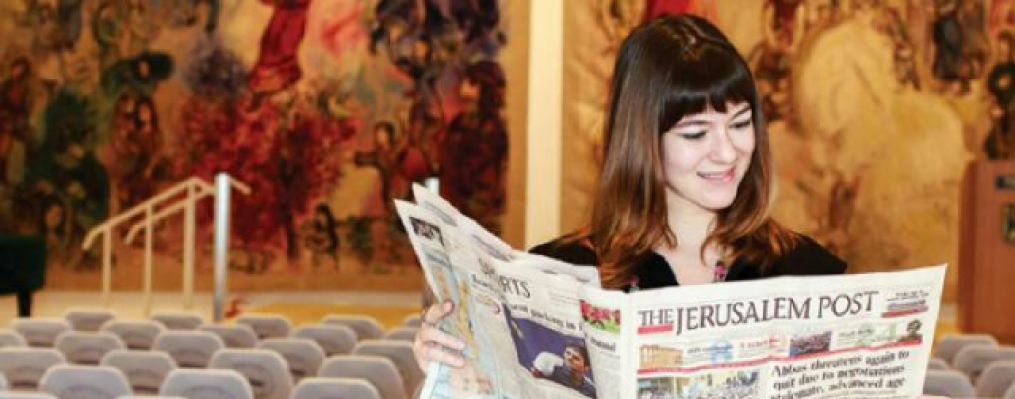

Book review: Fighting the PR war

Nachman Shai’s ‘Hearts and Minds’ examines how Israel can work on its public image.

Is

Israel the victim of bad PR? If it worked harder at presenting a positive image to the world, would tides change in its favor? Zionist Union MK Nachman Shai’s newest book, Hearts and Minds: Israel and the Battle for Public Opinion, puts this theory to the test.

Just over a month ago, Israel celebrated the opening of the US Embassy in Jerusalem, where the world’s greatest power officially recognized our country’s capital. But over the border in Gaza, people marked the day differently, continuing their weekly violent riots at the border. A Hamas-supported invasion attempt raged, with rioters throwing firebombs and shooting at IDF soldiers and into Israeli towns in the Gaza periphery.
The international news told a different story. They juxtaposed the smiling faces of the embassy opening’s attendees with the Palestinians killed at the riot. “Daddy’s Little Ghoul,” the front page of the New York Daily News read, next to a photo of US President Donald Trump’s daughter and adviser Ivanka Trump. “55 slaughtered in Gaza, but Ivanka all smiles at Jerusalem embassy unveil,” was the subheadline.

The story many people read wasn’t one of a nation proud of its history, defending its citizens. It was of a callous group of people grinning and cutting ribbons while killing dozens – never mind that it soon came out that the vast majority of those killed were members of terrorist organizations. Continue reading

The non-oppositional opposition in the Knesset

Pop quiz: Who gave the following effusive speech about Prime Minister Benjamin Netanyahu?

“Today, he deserves a lot of credit. Whoever says that [US President Donald] Trump would have moved the embassy [to Jerusalem] anyway, simply does not know how to give credit where it’s due. In my eyes, whoever doesn’t know how to give credit loses the right to criticize. This would not have happened without [Netanyahu] working on it, and I praise him for that.”
Is it a) Public Security Minister Gilad Erdan, b) Energy Minister Yuval Steinitz, c) Bayit Yehudi leader Naftali Bennett – in a generous mood – or d) none of the above?

If you guessed “d”, you’re right. As you may have guessed from the headline, this is – remarkably – a speech from the opposition. The supportive speaker was none other than Yesh Atid head Yair Lapid – the man who wants to replace Netanyahu as prime minister, no less. Continue reading

The government and left-wing NGOs: Denouncing one day, cooperating the next

Despite railing against them, ministries work with New Israel Fund grantees and Soros’s foundation.

For years, ministers and Knesset members on the Right have come out against foreign organizations and governments pouring funds into Israeli political NGOs as undemocratic and inappropriate, pursuing laws to limit the practice. However, The Jerusalem Post has found several examples of government cooperation with the very groups it has denounced.

Continue reading

Will Netanyahu use the migrants controversy to call an election?


A stressful situation can trigger a “fight or flight” response in people and other mammals, a “near-instantaneous sequence of hormonal changes and physiological responses [that] helps someone to fight the threat off or flee to safety,” according to the Harvard Medical School website.

The body can overreact to non-life-threatening situations, “such as persistent worry about losing a job,” the site says.

This fight-or-flight dilemma is what Prime Minister Benjamin Netanyahu has been facing lately over the African-migrant issue.

Should he try to fight against the Supreme Court overturning the policy his political base favors? Or should he escape, using it as an excuse to call an election?

Last week, Netanyahu chose flight, and this week, signs show he may go that way once again.

Continue reading

Israeli-owned bus station in Poland built on Jewish graves

Egged denies responsibility for upkeep of 18th century Jewish cemetery.

Egged, Israel’s largest bus company, owns a bus station in Makow Mazowiecki, Poland that was built over a Jewish cemetery, The Jerusalem Post has learned.

And the company does not take responsibility for the crumbling memorial to the Jewish community, located on the bus station’s edge, in the town 77 km. north of Warsaw.

The date on which the old Jewish cemetery of Makow Mazowiecki was established is unknown, but the first known mention of it dates back to 1781, according to the Virtual Shtetl website operated by the Museum of the History of Polish Jews – Polin. It was in use until 1870, when a new cemetery was built.

During World War II, the Germans destroyed the cemetery; in subsequent years, tombstones from the cemetery were used to build sidewalks in the area and a bus station was built there during the communist era.

In 1987, local activists and descendants of Makow Mazowiecki’s Jews built a memorial out of tombstones salvaged in the area. The oldest tombstone in the memorial is from 1890.

Continue reading 

A memorial to Makow Mazowiecki's Jewish community

This memorial, built by local activists and descendants of Makow Mazowiecki’s Jewish community, is in need of a sponsor for renovation and upkeep. (photo credit: ALAN ABBEY)